
Essay · September 2026
The Four Archetypal Voices in Homeopathy
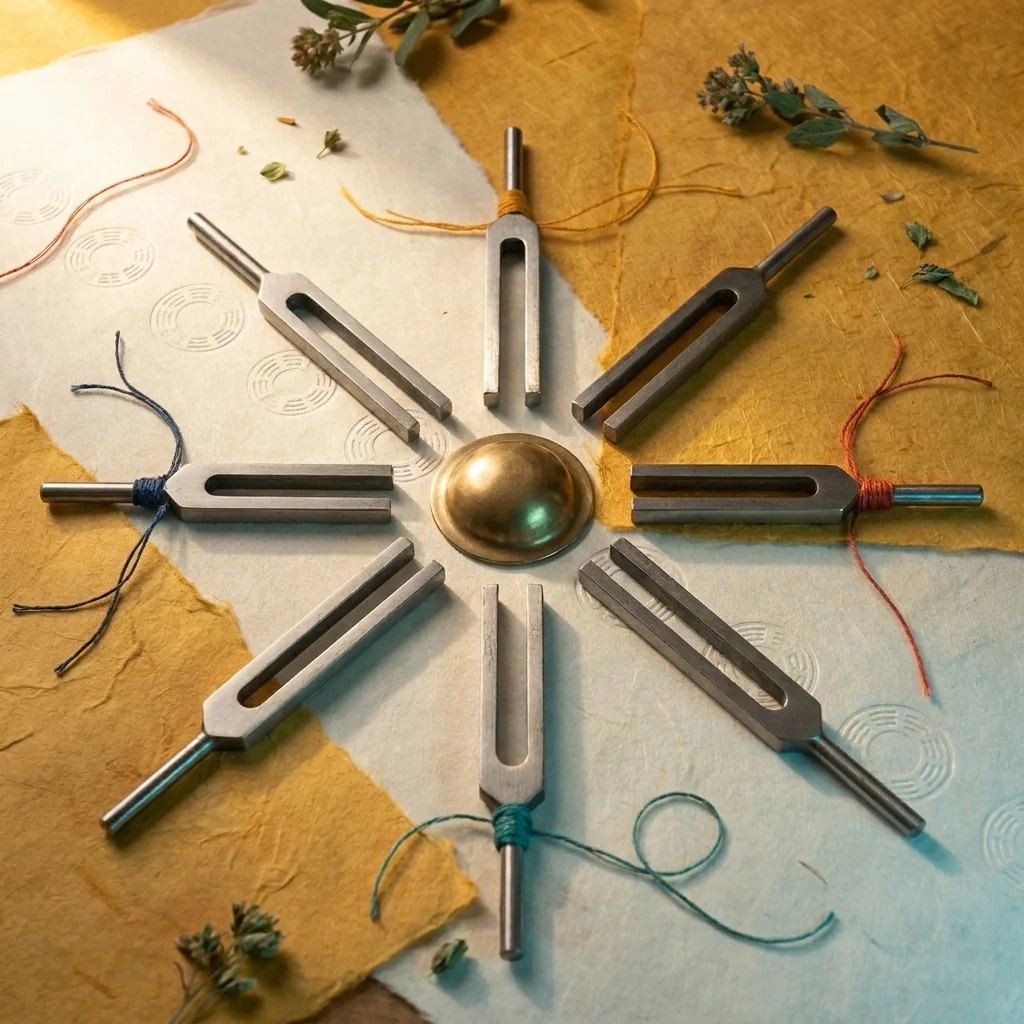
Republished here in September 2026 from my Archetypal Voices article.
A framework for understanding constitutional polarities through the I Ching Circle.
How to hear the call and response from a patient's deep archetypal voices, summoning their remedial allies from the homeopathic materia medica.
Introduction
This article introduces a framework I have been developing for the integration of Human Design with homeopathy. At its heart is a simple proposition: that the eight trigrams of the I Ching, when paired into polarities, reduce to four fundamental Voices through which the vital force becomes mistuned in illness. Each Voice describes a distinct way in which a person meets reality, processes experience and expresses dis-ease — and each gathers around itself a family of homeopathic remedies that hold particular resonance for that pattern.
The model is built on the three astrological bodies most directly involved in vitalistic medicine — Sun, Moon and Earth — and operates across three layers of analysis corresponding to disposition, constitution and miasm. It is designed to give the practitioner an oracular structure for case analysis, allowing the focus of attention to rest where the vitality is most stuck, rather than working harder to decipher the entire case at once.
The article is intended for homeopaths familiar with the kingdoms approach who are curious about Human Design, and for Human Design practitioners curious about the homeopathic correspondences. It begins with the I Ching itself, explains why Sun, Moon and Earth carry the keys to vitality, introduces the four Voices as a unified set, and then takes each in turn through its full range of correspondences. It closes with the clinical application of the framework in case-taking.
The I Ching and Homeopathic Reality
The I Ching is a circle of eight patterns, known as trigrams or Bagua, each composed of a different combination of yin (broken) and yang (solid) lines. This binary structure has appeared throughout history in unexpected places: it underlies digital code, it bears a striking resemblance to Morse, and it aligns with extraordinary precision to the structure of life itself. The 64 hexagrams of the I Ching match the 64 codons of DNA. The way DNA forms triplets, and the way RNA transcribes and morphs one pattern into another, mirrors the I Ching's changing lines. Change is at the heart of the I Ching, just as it is at the heart of holistic healing. To heal, we need to recognise where we are stuck and become willing to move.
There is a fascinating origin story within I Ching mythology. A primordial being, Fu Xi — half serpent, half man — saw the patterns of the Bagua on a tortoise shell and gained insight into the fundamental forces out of which reality springs. The I Ching, as a divination tool, was designed to put us in touch with the divine. This aligns beautifully with Hahnemann's principle that true health allows the spirit to fulfil its higher purpose through the body, suggesting that the highest level of health comes with discovering one's spiritual purpose.
The eight Bagua are the core building blocks of all the myriad patterns in life. When expanded into all possible combinations, they form 64 hexagrams — providing a mathematical mirror for the structure of life at the genetic level. This congruence points to the high possibility that there are 64 archetypal versions of reality. In homeopathic practice, one can easily bear witness to this phenomenon: there are only so many different imprints upon our patients' minds and bodies that present themselves to the unprejudiced observer. Delusion rubrics in the repertory reveal the filters through which patients have viewed reality when perceiving it through the distortion of illness. The goal in homeopathy is to see which filter the person is sensitive to, and to understand this version of reality — which is archetypal, not truly individual. Reducing the colouration of this filter allows a more pristine picture to present itself, so that flexibility and adaptability replace the fixed view of chronic illness.
Why Sun, Moon and Earth
When Jung used the I Ching with his patients, he would have them cast coins to generate a hexagram, drawing out a theme from the unconscious without the interference of conscious thought. Human Design takes a different approach: it works from the imprint at the moment of birth combined with a prenatal moment, giving a picture of both the conscious and unconscious aspects of the body and the energy working within it.
In medical astrology, the Sun, the Moon and the Earth are the three bodies most directly involved in vitalistic medicine. Each one corresponds to an aspect of the vital force as Hahnemann describes it in the Organon. The other planets carry significance for the broader psychological and karmic landscape, but it is the Sun, Moon and Earth that hold the keys to vitality itself.
The Sun represents the vital force. It is the source of life for our solar system, the heavenly body that radiates life energy. In Human Design, the Sun is seen as the source of information travelling through neutrinos, imprinting each person with a particular form made up of different combinations of the eight Bagua.
The Moon represents vital flow — how life energy moves through the body. The Moon channels the Sun's vitality, and its phase at the moment of birth gauges the depth and intensity of expression, from seed to full illumination and recession.
The Earth represents the body itself — the grounding element, the vehicle through which the vital force is expressed in physical form.
Working with these three bodies alone keeps the system rooted in classical homeopathy. The Sun and Earth give the dispositional voice; the Moon and its nodes give the constitutional voice; the relationship between Moon and Earth — through Lilith and Priapus — gives the miasmatic voice. Each of these is a polarity, and within each polarity an Archetypal Voice can be heard.
The Four Archetypal Voices
Rather than expanding out to 64 hexagrams, this model collapses them into four polarities, each representing what I call an Archetypal Voice. Each Voice is built from a reciprocal pair of trigrams, and within the bandwidth of each Voice lies a group of remedies that hold particular resonance and healing potential for the individual who hears that Voice most clearly.
This approach aligns with what Hahnemann refers to in the Organon as the Geist und Gemüt — the dispositional nature of the person. Disposition refers to how we meet external reality, shaped by personality and traits, and it also implies position within the group — a concept mirrored in the relational dynamics of the I Ching, which contains the stories of family and societal roles within each trigram.
The four Voices are:
- The Seeker (Thunder | Wind) — Ether and Air. The pioneer and escapist; initiation through shock; insight broadcast on the breath.
- The Refiner (Fire | Water) — Solar and Underworld. The mutator; constant transformation; alchemical refinement and dissolution.
- The Integrator (Lake | Mountain) — Water and Earth. The builder of coherence; absorption and elimination; embodiment.
- The Magnetiser (Heaven | Earth) — Yang and Yin. The primal binary; on/off, all or nothing; the stabilising axis.
Each pairs two complementary trigrams, creating a dynamic polarity analogous to the cation–anion bond in minerals or the predator–prey axis in animals. The dominant trigram colours the compensated presentation; the other surfaces in decompensation. This is similar to Sankaran's concept of the other song, where each person is attuned to a particular non-human melody. Within the bandwidth of each Voice, families of remedies — minerals, plants, animals — hold the resonance needed to bring the patient back into tune.
In case-taking, a patient's archetypal voice reveals itself through the themes they return to, the language they use, and the relational dynamics they describe. Just as animal patients spontaneously narrate their life story and mineral patients focus on performance and structure, each archetypal voice imparts a characteristic tonality to the case. The practitioner's task is to identify which voice is speaking loudest and to find the remedies that resonate within that bandwidth.
The dominant and sub-dominant key
Within each archetypal voice, one trigram acts as the dominant key and the other as the sub-dominant. The patient may present predominantly through one trigram while decompensating into the other. For example, a Seeker under the dominant influence of Wind may present as persevering, graceful and soothing, but decompensate into the shock, impulsivity and scattered energy of Thunder. The overall dynamic of the voice — in this case, Seeker–Initiate — remains in evidence throughout. This is the life theme, and accessing it in its pure form directs us toward the remedies that unlock the patient's higher purpose.
Three Layers of Expression
The archetypal voice operates across three layers, each accessible through different chart placements and each corresponding to a recognisable stratum in case-taking. The same four Voices apply across all three, though a person rarely has the same Voice dominant in all of them — more commonly there is a mix, with each layer speaking through a different Voice.
Disposition – the outer expression
Derived from the Sun and Earth placements, disposition describes how the patient meets the external world. This is the layer Hahnemann refers to as Geist und Gemüt — the dispositional nature. It encompasses personality, relational stance and life purpose. When this voice is loudest, the case centres on themes of meaning, identity and how the patient navigates their role within the group.
Cases of this kind tend toward the mineral kingdom, closer to the crystal of consciousness — a mineral has a defined structure and pattern, and it simply holds the role it is given. When unwell, that sense of purpose becomes disrupted, and this becomes the focus of the consultation. The dispositional voice is the foreground of the chart, the main actor in the movie.
Constitution – the inner compass
Derived from the Moon and lunar nodes, the constitution reflects the body's needs and the environmental conditions required for the individual to thrive. In Sankaran's terminology, these are the conditions for being OK — the background elements of setting, relationship and belonging that must be in place before the higher purpose can be accessed. When this voice is calling, the patient describes what they need around them and what environments feel safe or threatening.
The nodes, moving backwards through the zodiac, represent involution — a digging back into ancestry and karmic patterns, much like retrograde planets invite reflection and internalisation. Cases of this kind point toward the plant and animal kingdoms, where the relationship between organism and environment is the central drama. This voice often needs clearing first, particularly in the earlier stages of life. Only once it has been heard and responded to will the dispositional voice be allowed to speak.
Miasm – the conditioned response
Derived from the Lilith–Priapus axis, this layer describes the point at which the unbridled self was suppressed by collective expectation. The Moon's orbit around the Earth is not a perfect circle but an ellipse. The point where the Moon is furthest from the Earth is called Black Moon Lilith (the Lunar Apogee); the point where it is closest is Priapus (the Lunar Perigee).
Lilith was the first woman created by God, and she refused to submit to the dominance of Adam, explaining that they were created as equals and should enjoy the experience of give and take accordingly. For this, she was exiled from Eden to the wilderness, where she enjoys freedom, self-expression and motherhood without having her spirit subjugated. In the chart, Lilith shows where a person has the potential to be uncompensated — free, wild, letting go. These are qualities we naturally express more as children. But society says: that is not acceptable. Reign yourself in.
These societal expectations — the broad, collective imprints — are what homeopathy calls miasmatic. They are exactly that: imprints. At the point where the unbridled self tries to express itself, it gets squashed, and the person begins acting according to a specific miasmatic pattern. In Human Design, this is the not-self: the mentally conditioned version where the mind, and other people's minds, pressure a set pattern of behaviour that deviates from one's true nature. This distortion goes against the resonance of the vital force, leading to wastage of vitality and susceptibility to illness.
Priapus represents the overcompensated response — the attempt to correct what was denied by going into overdrive. Each archetypal voice connects, through polarity, to two miasms. The sarcode layer lives at the Priapus point, indicating which gland or tissue is working hardest to maintain homeostasis.
The sarcode and overcompensation
Nosodes and sarcodes are similar but different: nosodes are made from diseased tissue going into decompensation; sarcodes are made from healthy tissue going into overcompensation, trying to achieve perfect balance between the disparate parts that need to coordinate together to make the whole system work. It is very rare — if ever — that the body would choose a strategy of decompensation on its own. Decompensation is always a last-ditch effort to save the organism by sacrificing a particular region to infection. The body will always try to overcompensate first, even if doing so takes a monumental amount of energy.
Where a patient goes into overcompensation and overdrive — trying to make up for the wildness or the parts of them that others do not accept — that is where the sarcode will often be found. Priapus reveals the energy centre most in need of support, being the area where the person tries hardest to resolve the problem. Using this system, one can locate Priapus as a point in space, identify which I Ching gate it passes through (always opposite to Lilith), and determine which energy centre that gate lies in on the Human Design body graph. This gives a clue as to which sarcode may be indicated:
- Throat centre → Thyroidinum or one of the hormones released by the thyroid
- Ajna centre → the pituitary gland
- Sacral centre → the sex hormones, testosterone and oestrogen, and the matridonal remedies
- Heart centre → the cardiac sarcodes
- Root centre → the adrenals
The Seeker – Thunder | Wind
Escapist
Seeker patients are quick to perceive, restless to explore and hungry for meaning. They live close to the edge of insight and burnout, driven by momentum but often struggling to ground themselves. The mental picture moves in flashes — like lightning bolts of insight — and the case may feel scattered, jumping between topics with manic enthusiasm before suddenly withdrawing into introspection. They thrive on freedom and novelty but can collapse into numbness when overstimulated.
Polarity – Initiation versus escape
The Seeker oscillates between two states: the arousing burst of Thunder (initiation, shock, creative disruption) and the penetrating persistence of Wind (inquiry, flexibility, subtle influence). When compensated, they are visionary investigators and pathfinders. When decompensated, they escape — into substances, dissociation, intellectual isolation or literal flight from the group. The escape is not malicious; it is a withdrawal from a world that feels too rigid, too demanding or too slow to understand them.
Belonging and the outsider
Seekers often exist at the edges of the group. They crave connection yet fear the cost of conformity. There is a fundamental tension between wanting to be accepted and needing to remain free. In Scholten's plant phases, this maps to phase 1 (not yet belonging, fear of rejection, withdrawal) and phase 5 (secure but restless, wanting to expand, bringing benefit to the group but exhausting themselves in the process). The patient may describe feeling like an outsider, a disruptor or someone whose vision is never quite understood.
The eldest child dynamic
As the archetypal eldest child of the I Ching (Thunder = eldest son, Wind = eldest daughter), the Seeker often carries a heavy burden of expectation. They may have been pushed out into the world before they were emotionally ready, leading to hyper-independence, loneliness and a tendency to withdraw when their sense of purpose is not validated. There is a feeling of having to forge ahead alone, scouting territory for the group but receiving little recognition in return.
Emotional volatility
The Seeker's emotional world can be ecstatic or desolate, often within the same day. Their inner tone echoes the manic-depressive polarity of the acute and tubercular miasms: naive enthusiasm alternating with dark withdrawal. The emotional intensity is genuine but fleeting, and others may experience them as unreliable or unpredictable. In the patient's own words, they may describe feeling "on fire with an idea" one moment and "completely empty" the next.
Physical constitution
The body reflects the ectomorphic constitution: lean, mobile, easily affected by the environment. Vata tendencies predominate — dryness, cold, rapid metabolism. They eat frequently and in small quantities. Cranial emphasis, with accent on the sense organs, incisors, and the sensory-nerve pole of Steiner's threefold system. The immune system (spleen centre) and willpower (heart centre) are key affinities. Organs of relevance include the thymus, stomach, gallbladder and lymphatic system.
Miasmatic layer
The Seeker connects to the Acute miasm (shock, sudden threat, withdrawal) and the Tubercular miasm (intense, hectic struggle against chronic threat, restless need for freedom). The acute response is reactive and impulsive; the tubercular response is a sustained, burning search for escape from limitation.
Correspondences
I Ching: Arousing | Penetrating. Increase | Duration. Shock. Innocence. Decay, the Cauldron, the Well. Eldest son | daughter. Foot | Thighs. Dragon, volcano, earthquake, fast-growing reed | Cat, tiger, trees that bend.
Ayurveda: Ether | Air. Vata dosha: dry, light, mobile. Catabolic — breakdown. Ectomorph.
Alchemy: Calcination | Fermentation. Burning away impurities | Rebirth and growth from decay.
Lunation cycle: Crescent | Disseminating. Emergence of the seed idea, letting go of resistance. Need to act, to reveal insights.
Crystal systems: Monoclinic, Triclinic, Amorphous. These less symmetrical structures echo the Seeker's unconventionality and constant motion — a sense of being off-balance yet somehow finding footing again and again. In the amorphous (decompensated) form, there is incoherence, collapse into trauma and loss of self-containment.
Threefold system: Sensory pole. Cranial. Rapid metabolism, fast-paced, short-lived.
Plant theory phases: - Phase 1: They don't belong yet — fear of not being accepted leads to withdrawal or giving up trying to belong. Outsider, lonely, manic, naïve, unstable. - Phase 5: Secure but there is more to life. Expand possibilities, bring benefits to the group. Feel limited, want to enjoy freedom. Enthusiastic, expressive, lively — but exhaust themselves. Boasting, encouraging.
Remedy families
Plants (Phase 1 | 5): Ranunculales (Pulsatilla, Opium, Staphysagria). Balsaminales (Impatiens). Lamiales (Mint family). Fabales (Legumes). Laurales (Camphor). Nymphaeales (Lotus, water-dwelling).
Minerals: Monoclinic, Triclinic, Amorphous crystal systems. Phosphorus, Hydrogen, Neon, Helium, Alumina, Calcarea sulphurica, Nitricum acidum, Lithium carbonicum, Carbo vegetabilis, Magnesia carbonica, Muriaticum acidum, RNA. Also: drugs, imponderables, gases.
Animals: Spiders, Scorpions, Insects, Fungi (chitin, exoskeleton).
The Refiner – Fire | Water
Mutator
Refiner patients present with intensity, focus and a penetrating quality that cuts through superficiality. They are metabolisers of experience, constantly transforming one thing into another. Their cases often revolve around crisis, upheaval and the pressure to live up to superhuman expectations. They may describe feeling caught between opposing forces, unable to reach completion. The emotional temperature runs hot: passions flare quickly, guilt runs deep, and there is often a sense that something must change, whether in themselves or in the world around them.
Polarity – Before completion versus after completion
The Refiner's core dynamic is encoded in hexagrams 63 and 64 — Before Completion and After Completion — signifying a never-ending process of transformation. Fire (clinging, bright, intelligent) and Water (abysmal, hidden peril, depth) create a volatile, ephemeral partnership. When compensated, the Refiner distils complexity into clarity. When decompensated, they become chaotic, mutating endlessly through experimentation without resolution. The challenge is to use fire to forge rather than consume, and to trust the value of unfinished work.
The excluded visionary
Refiners frequently feel marginalised or invisible within the group. They see both sides of every question, bridging the gap between new ideas and established laws, yet their volatile, transformative nature can push them to the margins. In Scholten's phases, this maps to phase 2 (accepted but position fragile, having to earn their place, shy, submissive, easily belittled) and phase 6 (fear of having to leave, imbalance between giving and receiving, quarrels, being used or abused). The Refiner may feel like a middle child of the psyche: crucial but overlooked.
The middle child dynamic
As the middle child of the I Ching (Fire = middle daughter, Water = middle son), the Refiner is less bound by collective expectations and can navigate between roles with fluidity. This grants individuality and freedom but also leads to emotional displacement and invisibility. They become deeply self-reliant, expressing uniqueness by avoiding the defined tracks of elder and younger siblings. When under stress, they may isolate or martyr themselves, believing the transformation must happen alone.
Guilt, hope and superhuman expectations
The Refiner's emotional life is dominated by themes of guilt and hope. There is a relentless internal pressure to perform, to get it right, to live up to an impossible standard. They feel things profoundly but often redirect emotion into action or cause. The internal narrative frequently involves the question: am I doing enough? This maps to the psoric miasm (hopeful struggle with limited resources) and the cancer miasm (superhuman struggle against chaotic forces).
Physical constitution
Mesomorphic: muscular, warm-bodied, metabolically dynamic. Pitta qualities predominate — intensity, inflammation, heat sensitivity. Emphasis on the thorax, heart and lungs in Steiner's rhythmic system. Canine teeth, carnivorous tendency, short intestines, spotted or striped markings (rhythmical patterns). Key affinities include the solar plexus and crown centres. Organs of relevance: liver, nervous system, lungs, pancreas, kidneys, pineal gland, prostate.
Miasmatic layer
The Refiner connects to the Psoric miasm (hope — hopeful struggle with limited resources) and the Cancer miasm (guilt — superhuman struggle against chaotic forces). These oscillate between striving and collapse, ambition and self-destruction.
Correspondences
I Ching: Clinging | Abysmal. Before Completion | After Completion. The Clan, Fellowship | The Army, Conflict. Grace, Abundance | Oppression. Darkening of the Light | Youthful Folly. Revolution | Deliverance. Moulting | Dispersion. Middle daughter | son. Eyes | Ears. Peacock | Pig.
Ayurveda: Fire | Water. Pitta dosha: hot, sharp, focused. Metabolic — constantly transforming. Mesomorph.
Alchemy: Dissolution | Distillation. Balancing opposing changeable elements. Caught in the metabolic process of transforming one thing into another. Called to change direction before completion.
Lunation cycle: First Quarter | Last Quarter. Crisis of action, forceful will, actuating desires | Crisis of consciousness, awareness of what is no longer working, need to evaluate and correct.
Crystal systems: Trigonal, Orthorhombic. Trigonal captures the Refiner's desire to scale personal and collective heights — idealism, striving toward mastery, but fragility at altitude. Orthorhombic reflects the dualistic, instinctual side: a split between the sensing and thinking self, between raw empathy and mental processing.
Threefold system: Rhythmic pole. Middle (thoracic). Heart and lungs. Rhythmical markings.
Plant theory phases: - Phase 2: Accepted but position is fragile. Not established. They have to earn their place. Shy, submissive, follow rules. Being initiated. Insecure, easily belittled. - Phase 6: Fear they might have to leave. Lack of balance between giving and receiving. Used or abused — quarrels, discord. They give or take too much. Lazy, apathetic.
Remedy families
Plants (Phase 2 | 6): Gentianales (Nux vomica). Malpighiales (Coca). Dioscoreales. Rosales. Liliales. Ericales. Brassicales. Piperales.
Minerals: Trigonal, Orthorhombic crystal systems. Silicea, Calcarea carbonica, Tellurium, Sulphur, Halogens, many gemstones. Radium bromatum, Uranium nitricum.
Animals: Mammals, Snakes, Cnidaria, Cephalopods, Crustaceans.
The Integrator – Lake | Mountain
Separator
Integrator patients present with a gentle, layered quality. They process slowly but thoroughly, and their cases unfold over time rather than erupting in dramatic fashion. There is deep empathy, strong sensitivity to relational dynamics and an often unspoken wisdom that sits beneath a pleasing or neutral exterior. They carry shame more readily than fear, and frequently describe feeling blamed or scapegoated for others' pain. Their strength lies in weaving disparate elements together; their vulnerability lies in losing their own voice within the group.
Polarity – Openness versus containment
Lake (the Joyous — tender, sensual, inviting, attractive) and Mountain (Keeping Still — meditative, earnest, withdrawing yet grasping firmly) create a polarity of openness and containment. When compensated, the Integrator holds space beautifully, building cohesion and embodying continuity. When decompensated, they may become reclusive, stagnant or emotionally detached. The alchemical process here is Separation (defining a distinct self) and Coagulation (embodiment, integration) — the challenge of knowing where they end and the group begins.
The scapegoat and the steward
Integrators are the glue in the group, often putting others' needs above their own. In Scholten's phases, they map to phase 3 (unsure how to behave, conflict between self and group, guilt for going their own way, confusion of boundaries) and phase 7 (no position in the group anymore, rejected, thrown out, fighting for rights, parasitic quality, closed off). They may orient themselves around the Magnetiser, seeking to protect or support the one who holds vision, while neglecting their own leadership capacity.
The youngest child dynamic
As the youngest child of the I Ching (Lake = youngest daughter, Mountain = youngest son), the Integrator absorbs the atmosphere of the family system. In dysfunctional dynamics, they become the emotional pressure valve, receiving projection from all directions. In loving environments, they experience greater ease and affection, learning through reflection and empathy. Their gift lies in their ability to preserve the wisdom and cohesion of the group, often at considerable personal cost.
Shame, masking and slow digestion
The Integrator protects their inner world behind a pleasing or neutral façade. Their emotional process involves digesting complex experience over time — both literally and metaphorically, digestion is central to their wellbeing. They carry shame rather than fear, and may describe feeling blamed for things that were not their fault. The sycotic miasm (playing the game, facades, hiding shame from judgement) and the AIDS miasm (getting the blame, retreating as scapegoat) are active here.
Physical constitution
Endomorphic: robust, stable, soft, prone to stagnation or over-accommodation. Kapha qualities predominate — heaviness, density, slow metabolism. Emphasis on the abdominal cavity, molars and the locomotor-limb pole of Steiner's threefold system. Many-chambered stomachs, chewing the cud, turning the least nutritious food into the biggest body. Least protected, soft, vulnerable. Key affinities include the root and throat centres. Organs of relevance: adrenals, thyroid, parathyroids.
Miasmatic layer
The Integrator connects to the Sycotic miasm (desire — playing the game of facades and masks, hiding shame from judgement) and the AIDS miasm (innocence — getting the blame, retreating as scapegoat).
Correspondences
I Ching: The Joyous | Keeping Still. Decrease | Influence. The Marrying Maiden | The Wanderer. Conduct, Treading | Retreat. Inner Truth | Modesty. Opposition, Limitation | Development. Youngest daughter | son. Mouth, lips | Hand. Sheep | Dog. Hard iron core. Sorceress. Harvests. Twisted tree on mountainside.
Ayurveda: Water | Earth. Kapha dosha: stable, heavy, dense. Anabolic — building the body. Endomorph.
Alchemy: Separation | Coagulation. Defining a distinct self | Embodiment, integration.
Lunation cycle: Gibbous | Balsamic. Almost ripe, swelling, fullness | Ageing, reducing, preserving — endings are new beginnings.
Crystal systems: Hexagonal, Tetragonal. Hexagonal reflects community, efficiency and beauty in structure — team-oriented, sacred striving toward balance, but potential for fanaticism or control when overwhelmed. Tetragonal represents specialised flow: excellence in one direction, clear talents but sometimes lacking integration across domains.
Threefold system: Locomotor-limb pole. Abdominal cavity. Molars. Slowest metabolism, most robust body.
Plant theory phases: - Phase 3: Unsure, not knowing how to behave — conflict between self and group. Confusion of boundaries, guilt for going their own way. Gentle, pleasing, adapting. Vertigo, car sickness, nausea. - Phase 7: No position in the group anymore. Rejected, thrown out. Fighting for their rights. Unfair. Closed off, the cord is cut. Reserved, closed. Pointless to fight for their position. Expelled.
Remedy families
Plants (Phase 3 | 7): Malvales. Primulales. Violales. Campanulales. Boraginales. Apiales. Solanales. Cucurbitales. Sarraceniales. Santalales. Orchidales.
Minerals: Hexagonal, Tetragonal crystal systems. Graphites, Calcarea phosphorica, Nitrogenium, Cobalt. Many Lanthanides. Cadmium sulphuricum, Zincum salts, Mercurius salts, Emerald, Beryls, Stannum, DNA.
Animals: Fish, Amphibians, Gastropods, Sea mammals, Turtles, Tortoises, Crocodiles, Lizards.
The Magnetiser – Heaven | Earth
Polariser
Magnetiser patients present with a force of presence that commands attention — either through intensity of expression or through a striking quality of absence. Their experience of life is fundamentally binary: on or off, connected or disconnected, crisis or Eden. They are not blenders; they are anchors. The case may feel dramatic in its scope, with themes of oppression, confrontation, defiance and retreat cycling in stark alternation. They often know instinctively how to provide and protect, but they function best when they are seen, heard and acknowledged as the ones holding it all together.
Polarity – All or nothing
Heaven (the Creative — limitless potential, strength, pure yang) and Earth (the Receptive — gentleness, passivity, pure yin, nurturing, devotion) create the primal binary. This is the on-off switch of consciousness, the synaptic junction, the mitochondrial pulse. When compensated, the Magnetiser radiates vision, rule and clarity. When decompensated, they collapse into nihilism, emotional absence or syphilitic destruction. Their aura is the largest of the four voices; they attract others through magnetism, drawing people to support them or join their cause.
The pillar and the polariser
Magnetisers are often the central pillar of their family or community system. They hold the Father archetype from the I Ching (Heaven = Father, Earth = Mother), projecting vision, rule and distance. Others may respond with awe, fear or resistance due to their clarity and force of presence. The more yin-dominant types act as hidden anchors; the more yang-dominant as commanding presences. The magnet is also the polariser — the one who repels rather than attracts when the binary flips.
Crisis versus Eden
The Magnetiser's emotional life oscillates between extremes. They need to believe in something fully in order to show up. Ambiguity is intolerable. Their imagination is strong, generating excitement at the prospect of reaching full illumination — but when reality falls short, the disappointment is extreme. Love and meaningful recognition are their lifelines. They long to be drivers, not passengers, and their emotional development hinges entirely on trust and the capacity for nuanced engagement.
Binary thinking and the risk of rigidity
The Magnetiser's mind is decisive, uncompromising and precise. They experience life in absolutes and are intolerant of dissonance. Capable of both great silence and rare transmission, they are oracles of order who can see through illusion. Yet they must guard against harsh judgement and the collapse into nihilism. Their fixed identity makes relational vulnerability difficult. In the cubic crystal system, this is the most symmetrical and defined geometry — offering containment and safety, but also boxing in or suppressing emotion in the name of idealism.
Physical constitution
Solid, structured, intense. The body may be resilient or prone to systemic crashes depending on stress levels. Metabolism oscillates between hyper-efficiency and burnout. Sensitive to synthetic toxicity. Benefits from rituals that honour polarity: hot and cold, light and dark, activation and rest. Key affinities include the sacral, throat and mind centres. Organs of relevance: ovaries, testes, thyroid, pituitary.
Avian symbolism
Birds, aligned with the Heaven trigram, embody both literal and symbolic magnetism. Many migratory species navigate using Earth's magnetic field — magnetoreception. This mirrors the Magnetiser's inherent capacity to orient themselves and others within complex fields of relational and existential polarity. Like a flock's lead bird sensing unseen pathways, the Magnetiser functions as an unspoken axis within the system.
Miasmatic layer
The Magnetiser connects to Homeostasis (health, balance) and Acute/Syphilitic destruction. When the binary is functional, they embody vitality itself. When it collapses, the destruction is total — the syphilitic miasm in its most dramatic expression.
Correspondences
I Ching: Foundation of Yin | Yang. Power. Greatness. Creative | Receptive. Gathering Together, Massing, Holding | Splitting Apart. Peace | Standstill. Waiting, Contemplation | Breakthrough, Progress, Enthusiasm. Father | Mother. Head | Belly. Horse | Cow. Ice, fruit, tree trunk, cart, carrying.
Ayurveda: Prana, Agni — Breath, Vital Force. Choleric | Phlegmatic. Connection | Disconnection. On | Off. Binary. Central nervous system.
Alchemy: Conjunction. Integration and union versus cataclysm and breaking apart. Balancing forces that are highly polarised.
Lunation cycle: Full Moon | New Moon. The seed is revealed — excitement at the prospect of reaching full illumination. Strong imagination versus extreme disappointment when it doesn't go your way.
Crystal systems: Cubic. The most symmetrical and defined of all crystal systems. Order, structure, predictability, binary control. Compartmentalised psyche with strong sense of rules, roles and expectations. Offers clarity and reliability but creates vulnerability to rigidity, perfectionism and burnout.
Plant theory: - Phase 4 | Sub-phase 4: 'Type' plant families. Trees. The established centre of the group structure.
Remedy families
Plants (Phase 4 | Sub-phase 4): Asterales. Sapindales. Fagales. Rubiales. Caryophyllales. Commelinoids. Magnoliales. Trees.
Minerals: Cubic crystal system. Many metals and mineral polycrests. Natrum muriaticum, Arsenicum, Aurum, Cuprum, Ferrum, Niccolum, Iridium, Argentum metallicum, Plumbum, Magnetis polus, Diamond.
Animals: Birds, Bivalves, Worms, Sponges, Corals.
Elemental Signatures
Seeker (Thunder | Wind) – Ether and Air
This archetype embodies movement through space. Thunder represents the chaotic, creative burst (Ether), while Wind represents focused, directional breath (Air). In decompensation, the Seeker dissolves into Ether: ungrounded, foggy, numbed out — the drug state. Type remedies include Opium, Lithium carbonicum, Hydrogen and Helium — all suggestive of floating, disembodied, gaseous qualities. The Wind component brings back purpose, with Phosphorus representing radiant connection and responsiveness.
Refiner (Fire | Water) – Solar and Underworld
This pair is ephemeral and in continual flux. Fire symbolises radiance and the warmth of coming together by the hearth. Water represents the emotional tide seeking unity. The Refiner never stands still, metabolising change internally and externally. Their evolutionary dance is encoded in hexagrams 63 and 64 — Before and After Completion. Archetypal remedies include Sulphur, the Halogens and Silicea.
Integrator (Lake | Mountain) – Earth and Water
Lake and Mountain form a polarity of openness and containment. The Earth element of Mountain grants structure and stability; the Water of Lake enables absorption and emotional fluidity. This is the realm of the digestive system, especially the colon. The Integrator's gift lies in grounding experience and maintaining continuity, but stagnation leads to melancholic heaviness or reclusive detachment. Remedies such as Calcarea phosphorica, Graphites and Emerald reflect this deep earthy integrity mingled with emotional protectiveness.
Magnetiser (Heaven | Earth) – Yang and Yin
The primal on-off switch. Heaven initiates, Earth manifests. Triple yang and triple yin mark this as a study in absolute polarity, relating to the synaptic junction, mitochondrial pulse and cellular division. Magnetiser types oscillate between activation and collapse, brilliance and burnout. Their archetype expresses the nobility and gravity of metals: Aurum, Platina, Ferrum, Natrum muriaticum. High-performance constitutions with perfectionistic tendencies and sensitivity to pressure and failure.
The Relational Matrix
The four voices exist in dynamic relationship to one another. The Seeker and Integrator sit adjacent, connecting to both extremes. The Refiner and Magnetiser sit at opposite poles, distant from one another. Understanding these adjacencies helps the practitioner recognise when a patient is presenting a blend of voices, or when one voice is masking another.
Seeker
Core axis: Crescent–Disseminating. Relational position: insight, intuition, wisdom, spreading. Psychological role: initiator, questioner. Symbolic image: spark, lightning.
Refiner
Core axis: Before–After Completion. Relational position: excluded visionary, seer. Psychological role: catalyst, outcast, shaman. Symbolic image: firestorm, torrent. Distant from the Magnetiser.
Integrator
Core axis: Gibbous–Balsamic. Relational position: adaptive bridge, inner space holder. Psychological role: supporter, mediator. Symbolic image: hearth, soil.
Magnetiser
Core axis: New–Full. Relational position: fixed axis, central pillar. Psychological role: arbiter, judge, fulcrum. Symbolic image: compass, bird, magnet. Distant from the Refiner.
Clinical Application
Identifying the archetypal voice in case-taking
The archetypal voice reveals itself not through a single rubric or symptom but through the tonality of the case as a whole. The practitioner listens for recurring themes, characteristic language, relational dynamics and the patient's relationship to their group. Each voice has a distinctive presentation:
Seeker patients speak rapidly, jump between topics, describe flashes of insight and periods of withdrawal. They use language of exploration, escape, freedom, discovery. They may describe feeling like an outsider or pioneer.
Refiner patients describe intensity, transformation, crisis. They speak of guilt, hope, bridges between old and new. There is often a sense of being caught between opposing forces. They may describe superhuman effort or exhausting experimentation.
Integrator patients present slowly, thoughtfully, with emotional layers that unfold over time. They describe shame, blame, belonging, sacrifice. They may mask their inner world behind a pleasing exterior. Digestive metaphors are common.
Magnetiser patients present with force and clarity or with striking absence. They describe life in binary terms: all or nothing, crisis or Eden, connection or disconnection. They may describe being the pillar that everyone depends upon.
Working with the three layers
When the dispositional voice is loudest — the patient speaks about meaning, purpose and their relationship to reality — the practitioner focuses on remedies aligned with the Sun/Earth placement. When the constitutional voice is calling — the patient describes environmental needs, obstacles to cure and maintaining causes — remedies aligned with the Moon/Node placement take priority. When the miasmatic layer is most activated — the patient describes conditioned responses, societal suppression and compensatory overdrive — the Lilith/Priapus axis guides toward the appropriate nosode or sarcode.
In practice, the constitutional layer often needs clearing first. Only once this voice has been heard and responded to will the dispositional voice be allowed to speak. There will also be times when the nodes are activated and the environment seems to encroach on the individual, testing whether they are in their correct setting. This is particularly common in the earlier stages of life, where remedies relating to the environmental compass may be needed before the deeper purpose can be accessed.
Thinking smarter, not harder
The common pitfall is to exhaust oneself trying to find the perfect similimum for the Will, when actually the miasmatic load is too strong and the vital force will not react sufficiently to any remedy until that conditioning has been exposed. Or to aim at the dispositional layer when the constitution is calling for attention first. Having the framework of the four Voices allows the homeopath to focus on building trust and rapport, guiding the questioning into areas where the patient will respond — thinking smarter rather than working harder.
Archetypal Geometry and the Original Axis
In the Fu Xi arrangement of the Bagua, the Fire–Water axis was originally placed as the vertical core. This speaks to a deeper understanding of the Refiner as a once-central but now marginalised archetype — the sage, seer or shaman whose role has been pushed outside the mainstream collective due to their volatile, transformative nature.
These are the sulphuric and halogenic figures of homeopathy — those who see too much, feel too deeply, and challenge social norms. Remedies like Magnesium muriaticum, Silicea and Calcarea carbonica reflect these tensions: caught between an urge to serve and a deep-seated doubt or detachment. They are often middle children of the psyche — invisible, orphaned, yet crucial.
Fu Xi himself was depicted as half-man, half-serpent, resonating with the archetypal bridge between Mammals (Fire) and Snakes (Water). This symbolism reinforces the Refiner's serpentine role: agent of transformation, initiator into chaos, purifier through immersion. The serpent who first read the tortoise shell was, in the symbolic logic of the system itself, a Refiner — a reminder that the framework of the four Voices begins and ends with the act of seeing through transformation.
What Comes Next
I have set out the foundations of the framework: the I Ching origin, the three vitalistic bodies, the four Voices, the three layers and their clinical application. In subsequent pieces I will turn to the animal kingdom mapped through the eight trigrams — a complete evolutionary circle from sponges to birds, providing the constitutional layer with its phylogenetic depth. Beyond that, case examples will illustrate how this approach helps to prescribe polycrest remedies with greater confidence and precision. The model becomes much clearer when seen in action — and the integration of Human Design with homeopathy reveals its true value when it sharpens our perception of where the patient's vitality is most stuck.