
Essay · September 2026
An Introduction to the I Ching
Republished here in September 2026 from my Archetypal Voices article.
Yin and Yang, Polarity and Archetypes in Homeopathy
By Luke Norland
Learn the basics of my Archetypal Voices model, which synthesises Human Design, polarity and the I Ching into a practical clinical framework for use in homeopathy.
Welcome to this site, which is a developmental Human Design framework for integration with homeopathy, taking the I Ching – with its fundamental grammar of yin and yang – as the basis for understanding how health moves into polarity in illness.
An integral part of this process has been learning the Human Design System, a modern synthesis of the I Ching, the chakras, Kabbalah and astrology. The underpinning comes from the 64 hexagrams (gates) of the I Ching, the ancient Chinese Book of Changes. This is an oracular tool that allows the subconscious to have an influence over decision-making when one is challenged by difficult circumstances – something known as a befallment in homeopathic language.
This is a fundamental tenet of Human Design: that the mind is not the correct instrument for true decision-making. Instead, authentic decisions arise from the innate intelligence of the body. The mind is not a motor, capable of driving the Will. It is a processor of past, present and future - it sorts, collects and analyses various inputs, then reasons about potential outputs. That’s it, it cannot give you a gut feeling about something. The Human Design System offers a blueprint which reveals how genuinely-felt decisions can be made, honouring the energetics of each person's unique design.
After learning the fundamentals of this intriguing framework, I could see strong parallels with homeopathy, particularly relating to the themes of the six lines which form the hexagram. These ‘profile’ lines describe an orientation along an evolutionary track, much like the models already familiar to homeopaths: the Periodic Table of Scholten, the Plant Table of Yakir, and the Animal Table of Ghandi. Human Design and Homeopathy are both aimed at restoring the sovereignty of the individual and understanding the energetics of the body.
From complexity to simplicity
After much research and refinement, I came to the recognition of a need for simplicity. Human Design is a complex system which reveals the potential of individuals to transcend the trappings of mental and societal conditioning, so that the life purpose can be enjoyed through what is called passenger consciousness – becoming the observer. However, as homeopaths, we meet our patients through the language of their disease, expressed through the laws of nature. We see the susceptibilities; the constitutional weak points; the miasm exerting its influence in lessening the flow of vitality in the system. Our role is listening to and observing the deviations from the former healthy state into disease. This requires an approach which is not so geared towards understanding individuality as is commonly discussed. We all say that homeopathy is wonderful because we treat the individual, and we do - more so than almost every other modality. But actually, I offer the suggestion that we treat the archetype more than the individual. Hence the reason many traditional forms of medicine use systems of typology as useful frameworks. We simplify into our polarity type when we’re ill, and become more fully individuated having undergone the continual process of healing. The layers of each person described Hahnemann and Kent are tried and true, and the Archetypal Voices model builds upon this lineage.
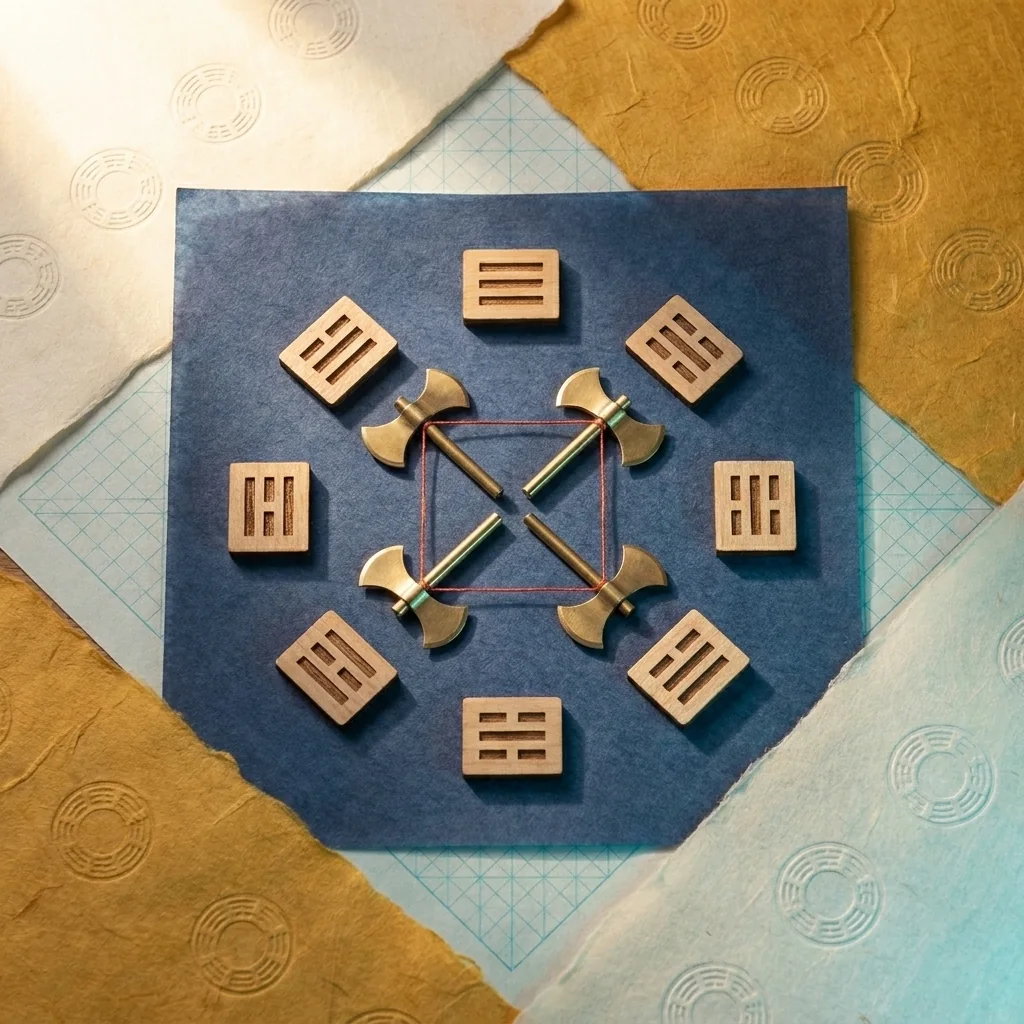
The more I researched, the more I sensed the possibility of going directly to the source of the Human Design synthesis itself – the I Ching. I began looking at images of the Bagua (trigrams) and how they are organised around a circular mandala. I started to perceive connections between this and the Mappa Mundi circle, something very familiar to me as a homeopath (and son of Misha!). The Mappa Mundi is helpful for mapping symptomatic polarity so that one understands the energy of a case. I envisaged that the I Ching circle could be used for a similar purpose, but with some interesting new dimensions.
Both the I Ching and the Mappa Mundi orient us within a fundamental truth of healing: that we function through polarity.
Polarity – the governing principle
What I appreciate about both the I Ching and the Mappa Mundi is that they orient us within a fundamental truth of healing: that we express dysfunction as polarity, the separation of wholeness into a binary pattern that is seeking to resolve itself through symptoms. Both systems depict this with a circular mandala, which also depicts wholeness, with health visualised as a point in the middle. In this point of homeostasis, we're capable of reacting and responding to any influence, by expressing the opposite, which allows the dynamis to swing back to the midpoint. Hahnemann teaches this principle in the Organon, where he describes the equal and opposite action and reaction of the vital force, which he calls primary and secondary action. When we become stuck in a particular state, there is a default drive toward resolution, and this expresses itself through symptoms. Those symptoms manifest along a polarity, and their purpose is to restore homeostasis.
Taking this governing principle and applying it to the I Ching circle, I could see that there are four reciprocal pairs of trigrams that are strongly archetypal: Heaven–Earth, Lake–Mountain, Fire–Water and Thunder–Wind. These 4 polarities describe 4 fundamental gestures in natural systems. Namely, to - initiate (inspire and broadcast the idea). - merge (dissolve, distill and synthesise the old with the new). - evaluate (separate the parts then bind back together so the new creation can be absorbed and understood). - magnify (unify and radiate the consolidated energies to one common purpose until the energy is exhausted, then collapse).
Well, that’s the gist of it! I could only understand any of this by overlaying lots of existing systems on top of one another, in like-fashion to the Human Design synthesis. That was very inspiring to learn about and apply it in a different way, which lends itself towards Homeopathy, through the shared principle of Polarity. This website will make it easier for people to see the different systems pulling together in one system to enhance existing understanding. The model combines Tumminello’s Crystal systems, the phases from Scholten’s Plant Theory, Ayurveda, the Alchemical stages, the Lunation Cycle, and the I Ching. It uses the same framework as Human Design for interacting with the I Ching mandala based on birth times, but offers a much simplified view of the Human Design body graph.
I wanted the system to have practical value, going one step further than the Mappa Mundi by organising remedies and families around each pair. I decided to call these four pairings Archetypal Voices. Each one gives voice to a recurring pattern described by the I Ching, expressed through polarity in illness and reflected in the remedies gathered around it.
Acute and chronic polarities
The Mappa Mundi offers particularly clear polarities for acute states – situations where symptomatology is strongly polarised and seeks rapid resolution. The I Ching, on the other hand, addresses a deeper level of transformation. It is more concerned with chronic states of dis-ease.
When we look at the elements involved, we notice that some elemental pairings are resolving whilst others are frictional. In astrology, Fire and Air form a 180-degree opposition – a natural axis of resolution. Fire and Water, however, form a 90-degree square, creating friction rather than resolution. This kind of friction does not resolve easily; it demands awareness and conscious engagement with the themes involved. This is where the I Ching model becomes particularly useful for understanding chronic states in patients.
Archetypes and the collective unconscious
Like the Mappa Mundi, the I Ching is built on eight fundamental components. Carl Jung famously used it in his clinical work as a system of archetypes that helps one encounter the collective unconscious. What Jung called the collective unconscious is similar to what Rajan Sankaran refers to as the other song, and what Human Design calls the not-self. It is the shared field of consciousness out of which we resonate with remedies – natural substances that share a similar consciousness field. Remedies connect with those aspects of ourselves that are not yet integrated, the counterpoint to our everyday human identity.
When the eight trigrams are paired into polarities, they resolve into four fundamental patterns – the Archetypal Voices. My approach has been to map different models onto this circle of eight. For example, the eightfold structure can be reorganised into a heptagram, which gives access to alchemy with its seven stages, and to Scholten's plant theory with its seven phases. This pattern of seven appears repeatedly in nature: seven plant phases, seven alchemical stages, and seven crystal systems, as outlined by Peter Tuminello. When these sevenfold systems are mapped onto the eightfold circle, a central axis emerges.
What Jung called the collective unconscious is similar to what Sankaran refers to as the 'other song' and what Human Design calls the 'not-self'.
The Magnetiser – Heaven | Earth
In the I Ching, the most fundamental polarity is described as Creative and Receptive, or active and passive. This is the most basic yin–yang relationship. I call it the Magnetiser–Polariser, and its themes are organised around the expression of one's unique identity with purity of intention and a strong gravitational pull. Whether expressing yang assertiveness or yin receptivity, there are no half measures. It is a type of considerable extremes, yet paradoxically it can function as a stabilising axis within the family or community.
Magnetisers cannot easily be swayed from their own path, even when it has gone wayward – and this is often the very problem in their cases. Everything goes extremely well, until it doesn't; then there is an extreme fall. Aurum metallicum's powerful collapse from grace is the perfect example. Things are black or white, up or down, perfect health or chronic disease – nothing in between.
In the I Ching family system, Heaven is the Father and Earth is the Mother – creative and receptive. This pairing corresponds to phase four in Scholten's plant theory, associated with stability, responsibility and centrality within the group. Many large plant families, including trees, belong here.
The Seeker – Thunder | Wind
From this central axis arise three further blended types. The first is the Seeker–Initiate, represented by the eldest son and daughter – Thunder and Wind. Elementally, these relate to Air and Ether and correspond to Vata dosha: dry, mobile, and gas-like. The Seeker is driven to explore and initiate. When decompensated, this energy becomes escapist, dissociated or scattered, often followed by sudden insights that are broadcast outward.
The alchemical stages here are Calcination – Thunder burning away impurities – and Fermentation – Wind, which seeks and penetrates everything by disseminating the meaning of its discoveries. The plant theory phases are one and five. In Phase 1, there is no sense of belonging to the group; the individual makes sudden impulsive efforts to join in, then quickly withdraws. Phase 5 seeks to expand the network and possibilities of the group, just as wind prompts movement and communication along the airwaves. Vata is catabolic – it breaks things down. The sharpest insight comes after all the impurities have been burned away as unnecessary dross.
This is the terrain of the eldest son and daughter, who are chosen to go on the mission first and have the most expectation placed upon them to forge their own path alone.
The Refiner – Fire | Water
The Fire–Water pairing is associated with Pitta dosha: hot, sharp and metabolic. This is the archetype of the Refiner–Mutator, and it relates to the middle son and daughter. The middle child often occupies a shape-shifting role – initially the youngest, then no longer the focus once another child arrives. They tend to experience greater freedom than the eldest, but also less clarity about their place.
This dynamic is echoed in plant phases two and six, which are perpetually half-inside and half-outside the group. Phase 2 is characterised by striving for acceptance through initiation and effort – constantly proving oneself. Phase 6 carries the feeling of having given too much and being rejected or cast out. When we bring in crystal structures, particularly the orthorhombic system, we see affinities with Sulphur and the halogens – substances associated with over-giving, depletion and expulsion from the group.
Water in the I Ching represents chaotic, uncontrollable forces that must be endured rather than mastered.
In the I Ching, Water is called the Abysmal. It represents dangerous, unstable terrain where one false step leads into the abyss. Mythologically, this is the descent into the underworld – Gandalf's battle with the Balrog being a classic image. Through this descent, however, greater wisdom and power are gained. This is the territory of the Refiner–Mutator: wizardry, alchemy, gradual refinement or sudden mutation through trial and tribulation. Every heroic journey begins with a descent into difficulty. Water in the I Ching represents chaotic, uncontrollable forces that must be endured rather than mastered. In this sense, it aligns closely with the Cancer miasm. Fire and Water together describe a life lived in continual metabolic transformation, oscillating between partial belonging and exclusion, dissolution and refinement.
The Integrator – Lake | Mountain
In alchemy, the process of dissolution and distillation eventually gives way to coagulation and separation. Here, ideas that were initiated by the Seeker and refined by the Mutator are finally integrated into coherent, enduring structures. This is the archetype of the Integrator–Separator, corresponding to Lake and Mountain in the I Ching, and to Kapha dosha – the principle of building and embodiment.
Integrators bring things together, create stability and make ideas accessible to others. They relate to the youngest children in the family system: playful, connective, yet also capable of withdrawal and contemplation. In plant theory, this corresponds to phases three and seven. Phase 3 can occupy central roles but often at the cost of personal sacrifice, while Phase 7 stands apart from the group, bringing restraint and wisdom through solitude.
An invitation
I hope this introduction whets the appetite for approaching the I Ching as a model in homeopathy, combining its ancient system of change with modern developments in homeopathic thinking. If you would like to find out more, I am developing a website which contains a knowledgebase and the possibility to explore your own charts and see which Archetypal Voices are operating through your own design. Visit archetypalvoices.com to find out more, and feel free to email me if you would like to enter a discourse about it.
Pull-out quotes
- "The Human Design System offers a blueprint which reveals how authentic decisions can be made, honouring the energetics of each person's unique design."
- "Both the I Ching and the Mappa Mundi orient us within a fundamental truth of healing: that we function through polarity."
- "In the I Ching, Water is called the Abysmal. It represents dangerous, unstable terrain where one false step leads into the abyss."
- "Water in the I Ching represents chaotic, uncontrollable forces that must be endured rather than mastered."
Biography
I am Luke Norland RSHom, BMus, and I grew up sharing my family home with the School of Homeopathy. I have been immersed in the homeopathic way of life since birth and now practise internationally. Alongside my clinical work, I am Course Manager at the School of Homeopathy, an editor of Synthesis Repertory, and Scientific Coordinator for RadarOpus. I published Animalia in 2021 – exploring the themes of six animal remedy families through the lens of the Mappa Mundi. I am also the author of the Thematic Repertory and Synoptic Guide – a repertory which brings the Boger–Boenninghausen approach into an accessible, contemporary form. My first training was as a classical musician; I have played the French horn since the age of ten and still perform regularly in orchestras. I spent much of my twenties composing experimental electronic music. I am also a father of two, keen cook, nature lover, and student of astrology, mythology, the I Ching, and Human Design.