
Teaching
Mappa Mundi: a lesson in polarity
Open the interactive Mappa Mundi PDF (opens in a new tab)
A summer-school lesson on the circle of elements: fire, air, water and earth, the four temperaments, and how opposites show themselves in a homeopathic case.
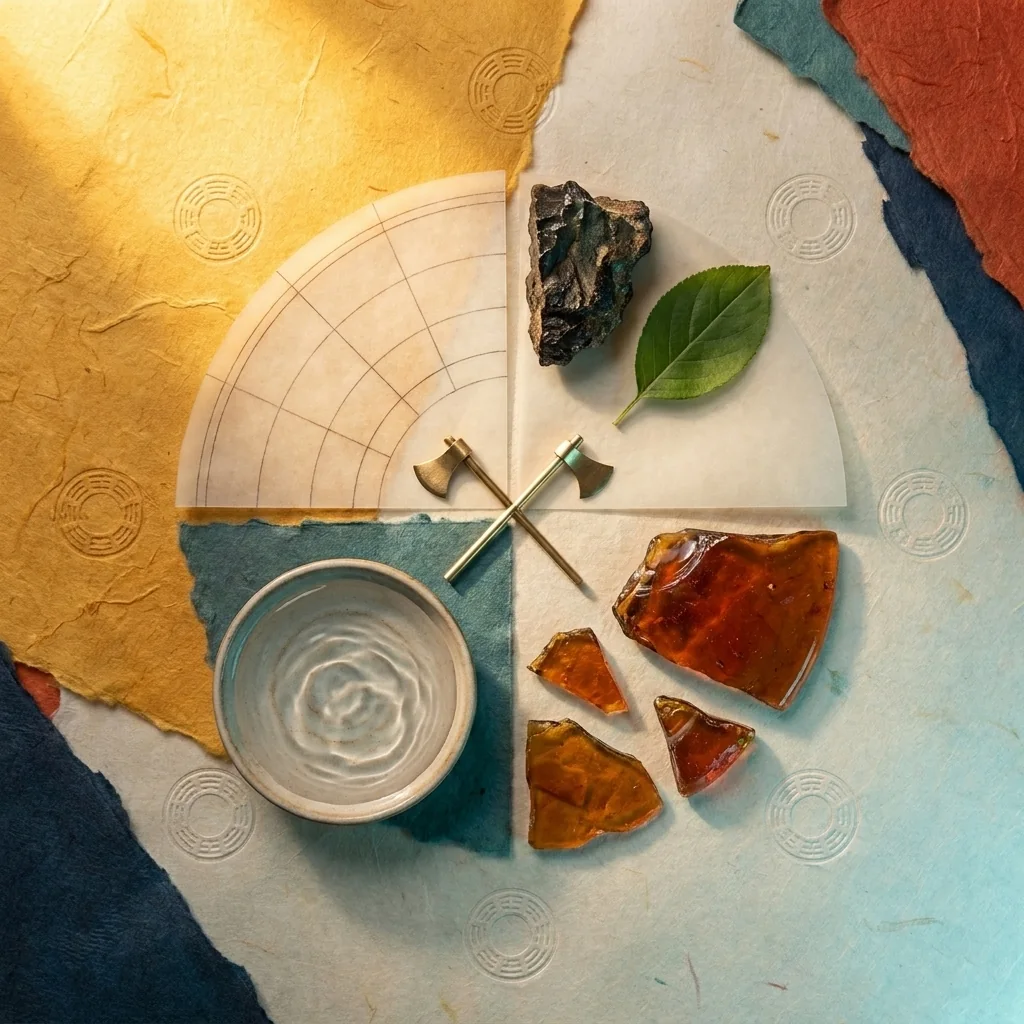
I taught this lesson over two sessions at a homeopathy summer school in June 2026. The Mappa Mundi places the four elements and the four temperaments around a circle, so that the opposites in a case, and the ways a person compensates for them, can be seen at a glance. The students' questions appear anonymously and in shortened form where they moved the teaching on. Here I set out the theory we used for the case work that followed; the cases themselves are not included.
Why a circle
The Mappa Mundi anchors you in one of the fundamental laws of healing: every action is followed by an equal and opposite reaction. Hahnemann sets this out in the Organon. Something happens to the vital force; it feels what has happened and answers with the opposite, and in doing so restores homeostasis. That is what healing is.
The ancient Greeks described two systems of medicine, one that works by contraries and one that works by similars. Conventional medicine works by contraries. It tests, finds the deficiency, and gives the drug that does the opposite. The vital force never gets to make its own correction, so it grows weak and lazy, and the patient ends up reliant on the medication. Homeopathy recognises the imbalance and gives a potentised remedy that matches the state. The remedy wakes the vital force up, as if to say: look at this disturbed pattern; correct it. The vital force then produces the opposite itself, and comes out stronger.
A system built on opposites keeps you close to that law, and it ties you to a lineage of healing that runs back to the Greeks. Mappa Mundi means map of the world; you can call it the circle of elements if you prefer. Homeopathy now has many tables. The periodic table is popular, with its eighteen columns and its several series, and it is complicated. A table takes you away from the nature of holistic medicine. A circle keeps you inside it.
Health is the midpoint
Picture health as standing at the centre of the circle. The compass points are the elements. When life asks for some of an element's energy, you move towards it and take what you need; when the need is over you come back to the centre, balanced again.
Illness is getting stuck. A person caught on one axis of compensation and decompensation is no longer at the midpoint, and reacts to everything through the distortion of the element they are predisposed to, whether that is fire, water, air or earth.
The layout: two axes and a clock
The traditional Mappa Mundi set each element with a temperament: fire with choleric, earth with melancholic, water with phlegmatic, air with sanguine. The model I teach is an upgrade on that. Fire and air form the vertical axis: heaven and the underworld, light and dark, life and death. Water and earth form the horizontal axis, wet and dry. The temperaments sit between the elements, each a combination of the two either side of it.
The circle also works as a clock. Fire is midday, the hottest hour, the sun at its height. Air is midnight: darkness, shadows, ghosts, fears and nightmares. Kent's hierarchy maps onto it too. The will, the domain of life and death, runs along the vertical axis of fire and air. The understanding, which takes things in, digests them and lets them go, runs along the horizontal axis of water and earth.
Polarity, primary and secondary action, compensation
Hahnemann's own illustration is the hand in hot water. Bathed in hot water, the hand is at first much warmer than the other one. Taken out and dried, it soon becomes cold, and then colder than the hand that was never bathed. The first effect is the initial action; the second is the reaction of the organism.
Do not become fixated on which is primary and which is secondary. It is a circle, and a person can stand at any point on it. Someone in front of you may be in the second reaction now and move to the other side later. What we need to know is that things happen in opposites.
In drugs the sequence is easy to see. Opium wakes and elates first; then come sleeplessness and withdrawal. A proving records what healthy volunteers experience after taking a substance prepared as a remedy, and there the sequence depends on each prover's susceptibility. Half a group may share one primary action and half another, and at some point they flip and go to the other side.
The honey fungus proving showed this movement between connection and disconnection. The first action was a strong inebriation, like a drug experience, with a heightened sense of connection. The second was a heightened disconnection, an other-worldliness. Fungus takes you to the underworld. Its mycelium is one of the largest living organisms on earth and is connected to everything, which is exactly the feeling the provers described. Honey fungus also destroys. When a tree is weak, the fungus takes it down at the roots, and in doing so often makes room for more life in the wood. It connects and it destroys.
Primary and secondary action, polarity, and the uncompensated and compensated states are one idea seen from three sides. A child with good parents is allowed to stay fairly uncompensated, so exploring someone's childhood often shows you what their uncompensated experience was. Authority figures and circumstances force a particular way of being, and that is where compensation begins. This links to miasmatic colouration too: the miasms are the imprint left by large collective experiences of disease.
From the room: primary and secondary action
Q. If it is a circle, can the secondary action lead back to the primary?
A. Yes. In that instance the secondary becomes the primary. Opium shows it best. This is why I say not to fixate on knowing which is which. In a proving, the prover's susceptibility decides where they enter the circle.
Q. When a patient speaks of being trapped, and also of flying and soaring, can I read the flying as the secondary action of the same organism?
A. Yes. When you explore a sensation and then its opposite, you are working with that duality directly. Sensation-based case-taking and the Mappa Mundi go together well for that reason.
Sensation and function: the verb
Jeremy Sherr's work on syphilis gives a helpful way into this, which I paraphrase. Paragraphs 9 and 10 of the Organon describe the healthy organism held in a dynamic harmony by sensation and function. These belong to the nervous system, the nearest physical expression of the vital force. Sensation reports a change; function answers it. Sensing cold, we warm ourselves; sensing hunger, we eat. Each opposes the other in a circular feedback loop.
Disease first appears as a distortion of that loop: feeling cold in warm weather, trembling without cold, hunger straight after eating. Sensation and function describe pathology more completely than emotions or delusions, because they belong to the whole organism. The same stuck pairing runs through the physical, emotional and mental levels of the case. Sherr calls it the verb: the one action a person is imprisoned in. In health we can respond with any verb. In pathology we are confined to one, and patients voice it as must, have to, should, need to.
Silica makes it concrete. The sensation is of being blocked; the function is to push through. It shows in the bashful stool, which begins to emerge and then recedes, and in difficult teething. It shows again in the abscess and the splinter that will not come out, and in the mind as the person who is obstinate yet yielding. Sensation and function, opposites and compensation: all of it is written into the circle of elements.
Where the circle comes from
The Mappa Mundi is the Western branch of an intuition shared across the ancient world: the human being is a small copy of the heavens, and health is the right mixture and proportion of a few elemental powers. Unani medicine is Greek medicine carried through the Islamic world; the word simply means Greek. Ayurveda works with ether, air, fire, water and earth, and combines them into three doshas: Vata from air and ether, Pitta from fire and water, Kapha from water and earth. Chinese medicine works with yin and yang, which come from the I Ching. Western medical astrology was used at the bedside by physicians for hundreds of years. The idea of the microcosm is less far-fetched than it sounds. Electrons circle a nucleus much as planets circle the sun.
Empedocles named the four elements. Hippocrates described the four humours (blood, yellow bile, black bile and phlegm) and tied them to the elements, so that health became a balanced mixture and its loss a faulty mixture, the dyscrasia of the old texts. Galen organised humours and temperaments into pairs, and that system governed Western medicine for some fifteen hundred years. When Galenic learning faded in Europe, scholars of the Islamic world translated it, preserved it and refined it. Paracelsus, a great forerunner of homeopathy, then Culpeper and the astrologer-physicians carried it forward. The scientific revolution set it aside: the body as machine, anatomy and chemistry, cell theory, the triumph of germ theory over terrain. The elemental and humoral accounts became old-fashioned.
In homeopathy the circle was revived by Joseph Reves, and taken up by those who studied with him, among them Misha Norland and Jeremy Sherr. Misha became its main exponent and wrote a book on it. Peter Fraser learnt it from Misha, worked with him on the provings, and wrote a set of clear primers. The older homeopaths knew the language already: Hering's symptoms use the words of the temperaments, and Nux vomica is described as choleric, dark and swarthy. The Greeks built the system for physicians, so it lends itself to resolving symptoms, and it carries a typology of its own.
My own aim is to find what unites these traditional medicines and bring it together in the service of the case and the prescription.
Polarity in the remedies
Yin and yang is the fundamental polarity, active and passive, and the glyph shows something essential: the seed of the opposite is always present inside the active state. It is the image of compensation and decompensation.
Remedies show their polarities plainly. Lycopodium fluctuates between cowardice and the dictatorial. Arsenicum swings between the fastidious and the chaotic. Where a remedy polarises is very often where its healing power lies.
Modalities, the circumstances that make a symptom better or worse, show the same thing in the body. A single factor the person is susceptible to will either aggravate or ameliorate, and where the state polarises is where the energy of the case sits. In an acute illness, collect as many modalities as you can; they need no interpretation. This is why polarity analysis, Heiner Frei's development of Boenninghausen, is so useful when you are starting out, and why a checklist of modalities sent to an acute patient can bring back strong indications.
Fire
When I ask a class about fire, the first words are motivation, will and passion. Drive connects fire to the will in Kent's hierarchy, which places the will above the understanding, and so to the heart, the main organ of the will, which drives the circulation. Blood is a combination of fire and water: hot and iron-rich, with water's ability to move.
The I Ching names fire the clinging. Fire cannot survive unless it clings to something, to wood, and so it is ephemeral. Taming fire changed us. As Richard Wrangham argues in Catching Fire, cooked food brought more calories and larger brains, and the hearth became the place where the group gathered after the hunt, where society began. For human beings, fire is the collective coming together.
In Misha's Mappa Mundi fire is light as well as heat. In the body its main expression is fever. In the wider picture fire is the sun and the sky, heaven and the spirit, connection and consciousness, an overview of everything. In the body it holds the heart, and also the eyes and the imagination. Western tradition often links fire with hell. That is not the fire of the Mappa Mundi. This fire does not destroy. It is the hearth that binds the hobbits together.
Fire is creative. The sun makes everything, and nothing lives without solar energy, so fire also governs the genitalia and the life of desire. Astrology gives it three signs. Leo, ruled by the sun and governing the heart, radiates: it loves and wants to be loved. Aries, ruled by Mars and governing the head, is excitable, spontaneous and reckless, acting before it thinks. Sagittarius, ruled by Jupiter and governing the thighs, is expansive and sees adventure and possibility in everything. Mars is the bringer of war, the hot-headed note in the choleric.
The fire person needs to use energy and will not sit still all day; that energy has to burn off, or it comes out in less desirable ways. They are vigorous and enthusiastic, sometimes brash or overconfident: abrupt, heedless, reckless, courageous, audacious, and at times self-centred, acting from the passionate heart.
Among the fire remedies, Aurum is the sun and gold, Apollo: desirable, noble, set on work and perfection, and never quite reachable. Oak is the Aurum of the plant kingdom; a tree has its roots in the soil and lifts its crown towards the light, the axis between heaven and the underworld drawn in wood. Lachesis, Belladonna, Lac leoninum (the lion, the sun, Leo) and Digitalis (the heart) belong here. The milks sit here because a central sensation of that group is connection and disconnection: feeling outside the tribe, unloved and uncared for.
From the room: fire
Q. What about the destructive side of fire?
A. The seed of the opposite is always present. The opposite of fire on this circle is air, and air in the Mappa Mundi is very dark.
Air: the underworld
People struggle with air's place on this circle. Air in astrology is light and expansive, the element of communication and networking. Air in the Mappa Mundi is dark and sinister. Whenever I say air, I think of the underworld: the light has gone, it is midnight, the fire is out. Think of the vertical axis as light and dark rather than hot and cold.
In the body air rules the nervous system and the lungs: the cerebral, spinal and respiratory systems, and the sympathetic branch with its fight and flight, cortisol and adrenaline. Fire rules the heart and the eyes; air rules the lungs and the ears, the breath and the sound wave. Air's pathologies include bronchitis, asthma, pneumonia, tuberculosis and pleurisy. Its affinities, the parts of the body it acts on, extend to the bronchial tubes, the pulmonary circulation, the thyroid, the vocal cords and the nerves. Together, fire and air make electricity: synapses fire.
In the mind, fire is inspiration and imagination; air is cold, hard logic. The sensations of air are chill, numbness and disconnection. Air also corrupts. Left in the air, metal rusts, silver tarnishes, wine turns to vinegar.
Its god is Hades, with whom there is no bargaining, and through him air connects to the syphilitic miasm. Only Hermes, Mercury, can travel from Olympus down to Hades and back, which is one reason the birds belong to this axis. The birds of prey live it fully: lords of the sky, then taken captive, tethered, their instincts trained out of them. That is the theme of abuse and domination. Misha chose the falcon for a proving on exactly this theme: when you take an animal of that majesty and make it a prisoner, the experience is overwhelming.
The Solanaceae belong here. They act on the sympathetic nervous system and grow and poison like the underworld: alkaloids such as atropine, deliriums peopled with monstrous figures, a long association with witchcraft, plants that grow in graveyards. The snakes belong here too. Their venoms are neurotoxic or haemolytic, attacking the nerves or disorganising the blood, and so they act strongly on both fire and air. Any life-and-death state, a severe acute or a disease of the syphilitic miasm, polarises along this axis. The drug remedies sit here as well, with ecstasy first and then darkness and disconnection as the secondary action.
From the room: air
Q. What do you mean by disconnection?
A. Alone, estranged, numb. The opium state, the state of withdrawal: not involved, not present, other-worldly, floating outside oneself.
Q. It feels to me more like space than air.
A. Yes, space and void, emptiness. The sanguine temperament holds more of the ordinary astrological air. Maybe whoever made this synthesis had it in for air types.
Q. I can't see why fire and air are polar. I only see the words.
A. It works best when you watch how they oscillate in the body: between fever and chill, between heart and lungs. Fever swings between heat and chills, and the commonest sequel to a fever is respiratory, the cough. They also work together, since fire needs air. It is fire and water that cancel each other: to put a fire out you need water. You can sit with the feeling of not being sure, and give it a try.
Q. Where does Carbo vegetabilis go? The fire has gone out of the digestion, and carbon is something in the air.
A. Yes. Hahnemann was an alchemist here. He asked what happens if you burn all the life out of something and reduce it to charcoal. Causticum and Hepar sulph come from the same thinking, remedies made out of a clear meeting of elements.
Q. Is there a fifth element, ether, that would account for electricity?
A. Not in this model, though Ayurveda has one.
Water
Water can freeze, evaporate, lie placid or rise as a tsunami; it crystallises into snowflakes. It wants to join with itself: it forms spheres, and runs from rain to river to sea, always looking for the larger body of itself. It takes the shape of whatever holds it. All the fluids in the body are governed by water, and we are mostly water, which is part of why homeopathy works, since a remedy is mostly water too.
Life began in water, and the sea is not a gentle nursery. Most sea creatures leave their eggs and move on; the young sort themselves out. The exceptions are telling: the whales, mammals that returned to the sea, and the seahorse, whose male carries the eggs. A cross-gender theme runs through the sea remedies, and some fish can change sex. In the deep sea there is no light at all.
In the Mappa Mundi water is fluidity, change, adaptation and cleansing: the fluids and discharges, the bladder and kidneys and adrenals, the womb to some degree, and the genitalia, which it shares with fire. In astrology water is the mother and the moon, cycles and tides, feeling, intuition and emotion. Air can carry too much logic; water can carry too little. It overwhelms, turns irrational, lacks solidity and structure. That is why Pulsatilla wants someone protective to look after her. Silica and Pulsatilla are the familiar pair: Silica earthy and logical, Pulsatilla watery, changeable, weeping and sympathetic, each leading towards the other across the axis.
Sleep shows the difference between the elements. If you cannot switch off the sympathetic nervous system at night, that is an air problem. Waking several times to pass urine is a water disturbance; water belongs to the subconscious, which comes alive at night.
In the I Ching water belongs more to the underworld, a chaotic and destructive element. An oceanic creature has nowhere to hide. The oyster builds the earth element around itself as a shell, and then leads an entirely passive life. Water can overwhelm until identity is lost, which is the territory of Alumina and the states that resemble dementia. Misha's proving of Aqua nova, newly formed water, tested the idea of water's memory with water that had none.
The Magnesiums belong here: passive, and liable to blow up, the pacifism and aggression Scholten describes. Natrum muriaticum is a leading water remedy that carries a great deal of dryness, since salt preserves and dries. The sea remedies are a large group, a few of them vertebrates, the fish, and most of them invertebrates: the oyster, the jellyfish.
From the room: water
Q. Is a tsunami earth and water together?
A. Yes, and it shows what water does when it overwhelms: it produces chaos, and you can lose your identity in it.
Q. Do the water remedies have an affinity with the moon and with sleep?
A. Compare the two kinds of sleeplessness. The person who cannot switch off has an air problem. The person who wakes to urinate has a water disturbance.
Earth
Earth is solid, heavy, structured, stable, grounded and contained. Gravity is its force. It is the opposite of water's fluidity and changeability, and water without structure becomes chaos.
The elements grow more solid as you go round. Fire is ephemeral. Air carries information, and you see the wind's effects rather than the wind. Water can be seen and felt, yet it moves. Earth is properly tangible; you can hold it, weigh it, put a value on it.
In the body earth is the skin, a bag that keeps everything in and everything else out, and the joints and the structure. It is also the kidneys that filter the urine, with the adrenals sitting on top, and the colon and intestinal tract. Digestion is the water-earth axis. Food enters a bag of acid, which is water; the goodness is drawn out, and the remainder grows drier and more solid until it is a stool. Memory and understanding belong here as well, since thinking is a way of digesting ideas. Pathologies of this axis include digestive complaints, and problems with time and memory such as Alzheimer's.
Earth is rigidity, routine and sameness: sticking to what you know and finding safety in it. Its mind is factual. Unless I can measure it and weigh it, I can't understand it. If I can't feel it, I don't trust it.
Here lies one of the strengths of the Mappa Mundi. You can say this is an earth case without yet deciding that it is row four or row two. Earth holds many groups of remedies, so you are not forced into an early decision that might be wrong. One of the seductive traps of modern homeopathic systems is jumping to a conclusion too soon and cancelling out many possibilities.
The metals carry an earthy rigidity; they make rigid structures, used to contain, store and defend. The whole of row four of the periodic table, where Cuprum (copper) sits, is earth. Cuprum is dutiful and goes by the book, and is so controlled that the control must come out as cramp and convulsion. Aurum is the exception among the metals, its nobility aligned with fire. Kali lives in the humus and the soil; vegetables that taste good are rich in potassium. Graphites and the carbons, the building blocks of organic life, are earth, and Scholten links carbon to the father, the man who does his duty, earns and builds the structure. Silica shows a water-earth polarity of its own. Sulphur burns and itches and is very fiery, and is earthy too. Lava is fire and water together.
The minerals carry earth through their crystal structure. The cube is the perfect container and very earthy. The hexagon is efficient, the honeycomb; Calcarea phosphorica, hexagonal, builds bone. Monoclinic crystals, with no right angles, are less earthy.
Among the plants, Symphytum knits bone back together, and Bamboo, which resembles the spine, is one of the newer spinal remedies. The grasses that became our grains, wheat above all, carried humanity from hunting and gathering into settled, ordered and routine lives; monoculture can be seen from space. Triticum is a remedy of weakness, and for the many people now intolerant of wheat it is a poison. Opium sits here as the main remedy for constipation, a dried-up intestinal tract, and the poppy is among the most cultivated of plants. I have compiled these assignments by joining rubrics, the symptom headings of the repertory, rather than by opinion. I would rather the data made the decisions.
The insects are strongly earth: structure, order, hierarchy, queens, control by pheromone, the recycling of matter back into the soil. Their life cycle has a long grub phase of eating and excreting, and then an extreme transformation in which the caterpillar liquefies inside its cocoon and reorganises its tissues entirely. That is a movement from earth to sky, and patients mirror it when they leave a mundane, routine life for something more conscious.
In astrology, Saturn stands on the earth side and the moon on the water side. Saturn, contained by its rings, rules Capricorn: skin, knees, joints, hair, dislocations, eczema. Saturn partners Jupiter. Jupiter says look at all the possibilities; Saturn says be careful, and brings limits, order and structure. The moon rules the bladder and the stomach, with gastric trouble, hiccup and flatulence. Carbo vegetabilis, charcoal, soaks things up and relieves the upset stomach full of wind, so it belongs to earth and water as well as to fire and air.
You can map the affinities of a case, the organs and systems it acts on, and find them on the earth-water axis, then map its sensation and find it on fire and air. You do not have to choose only one.
From the room: earth
Q. Is earth simply anything that grows?
A. No. The point about the grasses is agriculture: the move to a settled, ordered life.
Q. How does opium belong to earth?
A. Through constipation, the dried-up gut. It is our main remedy for it, and the poppy is one of the most cultivated plants we have.
Q. Where does a dragonfly fit the insects' movement from earth to sky?
A. It is an interesting difference, and worth exploring in its own right.
The four elements at a glance
Fire is imagination, creativity, spirit, desire and joy. Air is rational clarity and intellect, and also aversion and depression, which is a little hard on air. Water is feeling, absorbing, flowing, the lack of a boundary. Earth is the physical body, structure and sensation.
Jung's four functions sit on the same circle: feeling with water, thinking with air, sensation with earth, intuition with fire. The partner we are drawn to often holds our opposite elements; the earthy person lends dependability to the spontaneous one.
The temperaments
Each temperament combines two elements and sits between them. They pair across the circle on two axes.
Choleric and phlegmatic: active and passive
This is the axis of the dynamic and the static, of leading and following.
The choleric is hot and dry, a desert, an oven, the kiln. It brings energy and drive, action and bravery. Its sound is forceful, even shouting; its flavour is spicy; its planet is Mars; its hour is three in the afternoon; its organ is the liver and the bile. As an adult the choleric takes responsibility and makes the rules, which is the root of its dictatorial side. Nux vomica is the type: he gets things done by hook or by crook, and when he cannot do up a button he rips them all off, irritable and intolerant of contradiction. Lycopodium belongs here too: boastful, dictatorial and territorial at home, weak and mild at work under a superior.
Watch the law of opposites act on the choleric. They meet every situation with industrious eagerness, let's get this done, and much of life does not call for that. They burn out. Stimulants follow, coffee in the morning and drink in the evening, which weaken the digestion and burden the liver, and the liverish temper grows quicker to anger. In the end the only way back to the centre is collapse, rest by force.
The phlegmatic is soft, slow and passive, lying down. If the choleric is standing up and shouting, the phlegmatic is lying down and chilling out. The choleric leads; the phlegmatic follows, indecisive and faithful. It is water with air: mist, fog, drizzle. It belongs to the parasympathetic nervous system, rest and digest. Its hour is three in the morning, the liver hour on the Chinese clock, and waking then means the liver is struggling with the day's intake. The choleric's three o'clock dip is the reciprocal: stimulants in the morning, a large lunch, and by mid-afternoon the energy has gone and they turn phlegmatic. Samwise Gamgee is the classic phlegmatic, following Frodo all the way to Mount Doom.
Sanguine and melancholic: open and closed
This is the axis of letting go and holding on, of expansion and contraction.
The sanguine is hot and wet, fire with water: water heated until it bubbles. Sanguine people are fun, energetic, chatty and sociable. Phosphorus is the type remedy, with its affinity for the blood and the circulation. The sanguine hour is nine in the morning, bright-eyed and bushy-tailed; its sound is hopeful singing. Its stage of life is adolescence, with its innocence, optimism and sense that everything is possible. Misha gives the sanguine Venus; I would say Jupiter. The spleen matters here, and so does haemorrhage, since this temperament is too open. Phosphorus is a leading remedy for bleeding, from postpartum loss to nosebleeds. The sanguine loves company, parties and a little thrill, and wants the senses titillated, which brings in the pepper family and the mints, the herbs and spices.
The melancholic is the opposite pole: wisdom and restraint, withdrawal and contraction. Part of digestion belongs at the earth point, but its final stage, the colon, where you let go, belongs here. Its stage of life is old age; its planet is Saturn. At its best it is wise and restrained. At its worst it moans and complains and dwells on the negative, a pessimism that answers the sanguine's hope. It turns philosophical and introspective, heavy, resentful and jealous, its world contracted, brooding at other people's fun. The two meet when the old philosopher takes up with the young, optimistic student.
Lachesis lives on this axis. On one side she is open, loquacious, expansive and captivating; beneath runs a simmering melancholy and a brooding jealousy. The axis shows as a need to withdraw, to retreat to the cabin with books and screens, and then a need to come out, talk, expand and connect, and then to contract again. It can be an uncomfortable tension. The I Ching calls this point Keeping Still. Keeping still allows concentration; without it, attention scatters. The sanguine says yes to everything, what a lovely idea, I'll see you next Friday, until the social battery runs out and they must withdraw like a hermit to recharge.
From the room: the temperaments
Q. Where does the parasympathetic nervous system belong?
A. With the phlegmatic temperament, water and air: rest and digest.
Using the circle
Before you repertorise or analyse a case, sketch a portrait of the disease. That is hard when a patient gives you a great deal. Start by taking the characteristic language and symptoms from your notes and placing them on the circle without thinking too hard about where you are going. The pattern emerges, and the data tells you what it is. It is a mechanical step, a little like repertorisation, and there is something meditative about not thinking. Repertorise mechanically and you end up with garbage; do this mechanical step first and you have a portrait, and the repertory result will then match it closely.
As a student I looked for every rubric that fitted each element and temperament. In the Synthesis repertory you can find choleric or phlegmatic as rubrics and run an ordinary analysis, and the rubrics you choose for a case will show which temperament or element is coming through.
Keep both lenses. Map the affinities of the case, and map its sensation, and let them land in different places if that is what the case does. I use the Mappa Mundi to map the polarity of symptoms, and the I Ching circle to understand the nature of the person, their family origins and the groups of remedies they will need. The Mappa Mundi is good for acute work, the I Ching for chronic.
Further reading
Misha Norland's book on the Mappa Mundi gives the case studies and the alchemical origins in depth. Peter Fraser's primers are simpler and waste no words. Jeremy Sherr's writing on syphilis develops sensation, function and the verb. Richard Wrangham's Catching Fire tells the story of fire and human evolution. For the I Ching, Richard Wilhelm's translation, the one Jung used, is a good place to begin. The first section of my book Animalia covers the Mappa Mundi and maps the animal sub-kingdoms onto it.
The interactive Mappa Mundi (opens in a new tab) lets you click into each part of the circle, and Mappa Mundi and the Circle of Elements gives a shorter introduction to the framework.