
Essay · November 2026
Tinnitus: distinguishing six homeopathic remedy pictures
I compare Graphites, China, Petroleum, Pulsatilla, Kali carb and Phosphorus through the details that distinguish their tinnitus pictures.
This is a guide to traditional homeopathic remedy pictures, not a diagnosis or a promise of relief. For assessment and conventional support, see the NHS tinnitus guidance. Arrange a GP appointment for persistent or troublesome tinnitus; ask for an urgent appointment if it follows your pulse. Tinnitus after a head injury, or with sudden hearing loss, facial weakness or vertigo, needs A&E or 999.
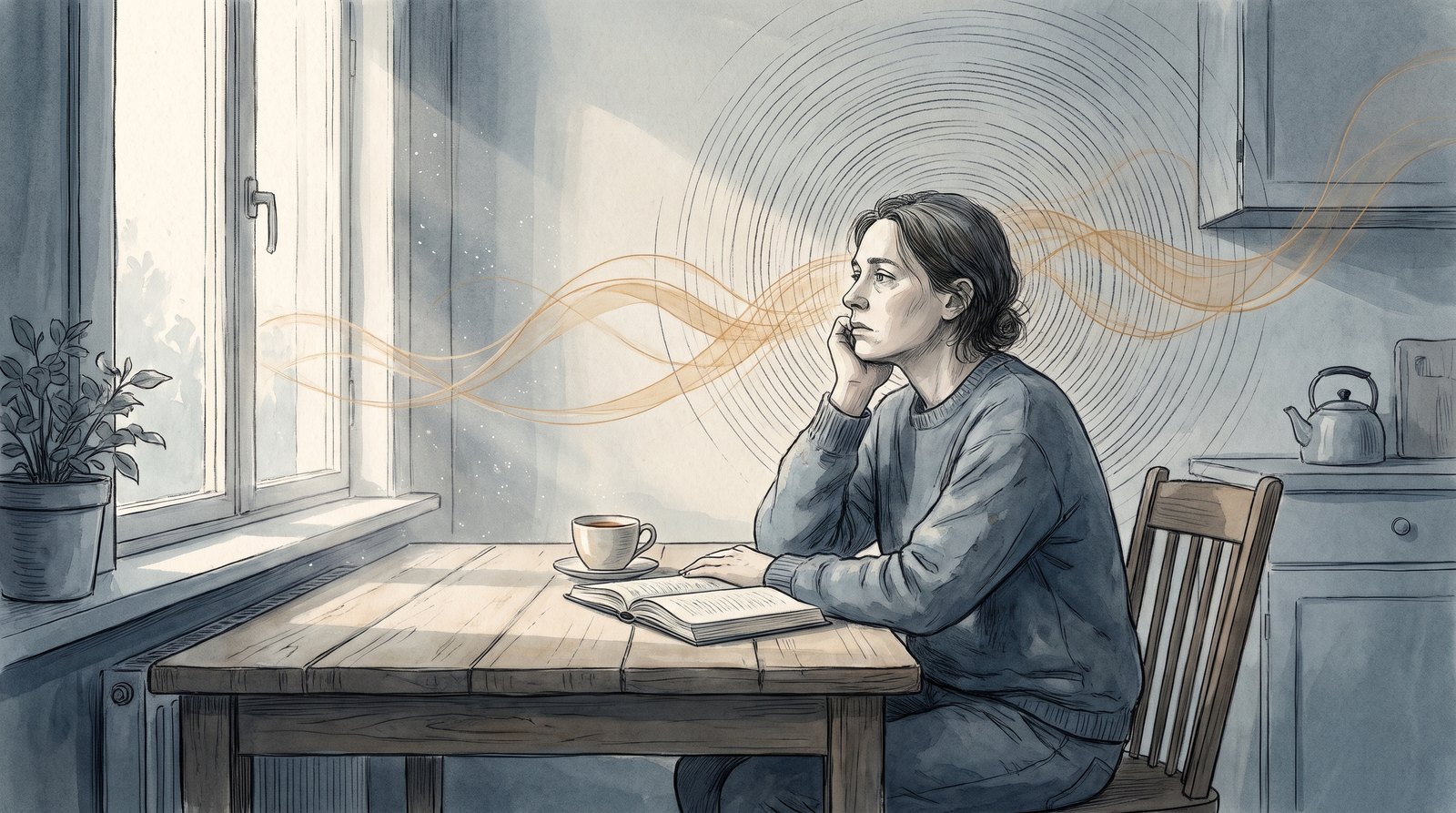
Tinnitus can make a quiet room feel anything but quiet. A ringing, rushing or humming sound may interrupt a book, a conversation or the moment you try to fall asleep. Yet the word tinnitus tells me very little about the particular experience: what the sound is like, when it intrudes, and what else is happening at the time.
Graphites, China, Petroleum, Pulsatilla, Kali carbonicum and Phosphorus all appear under ringing and roaring in the homeopathic repertory. Those broad descriptions barely separate them. The useful distinctions lie in the circumstances: hearing more clearly amid background noise, roaring during a cold, or a sound that changes with menstruation.
What happens between the ear and the brain
In ordinary hearing, sound vibrates the eardrum and the tiny bones of the middle ear. Movement within the cochlea stimulates sensory hair cells, which convert it into electrical signals. The auditory nerve carries these to the brain, where sound is perceived. NIDCD explains this hearing pathway.
With tinnitus, sound is perceived without an external source. Changes in signals through the hearing pathways, and their interaction with networks involved in attention and emotion, may contribute. There is no single explanation for every person. The NIDCD overview of tinnitus describes the current understanding and its limits.
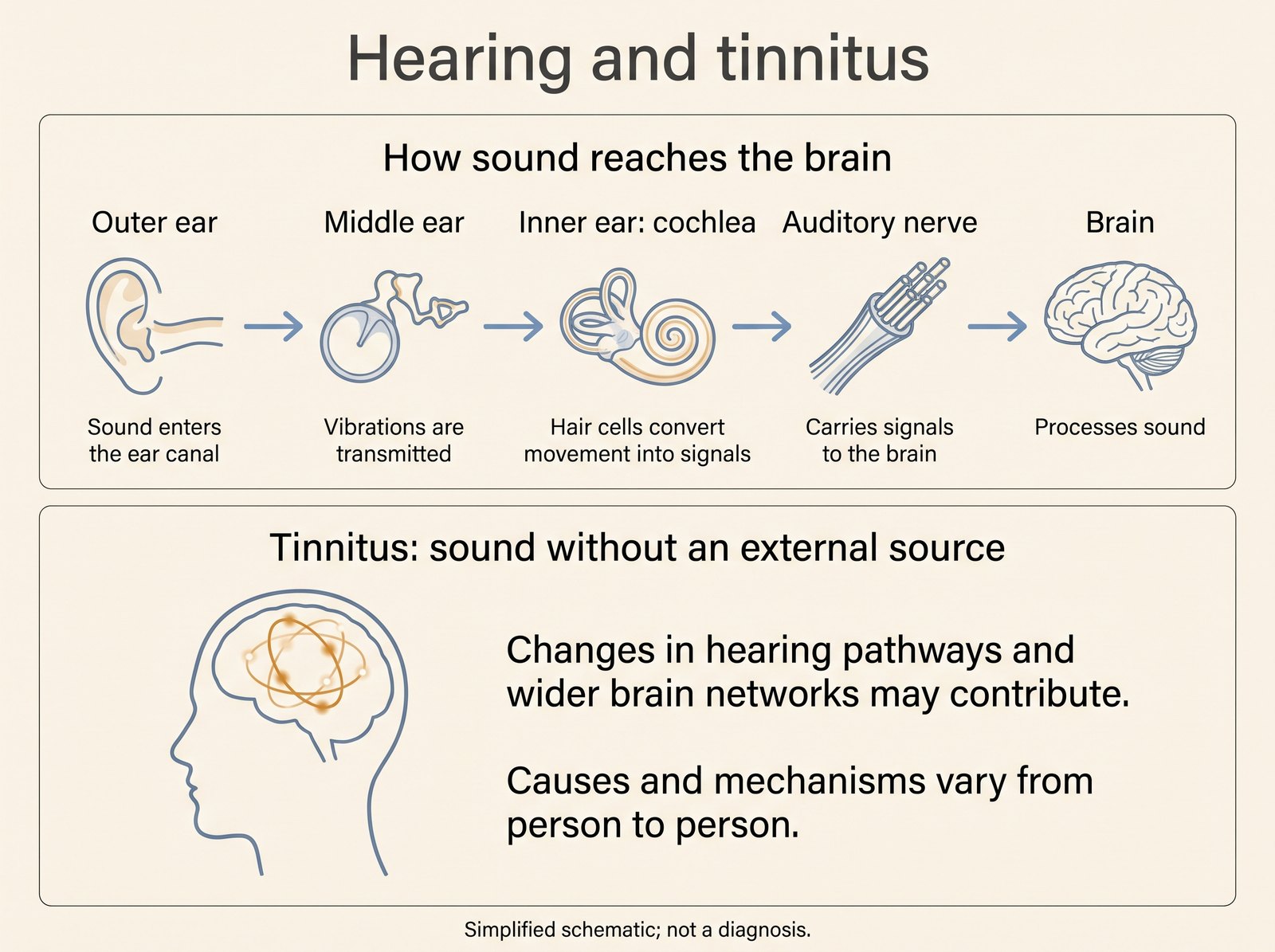
A simplified hearing pathway. Changes in hearing pathways and wider brain networks may contribute to tinnitus; mechanisms vary. Based on NIDCD’s hearing and tinnitus explanations.
The details that make a difference
A repertory is an index of symptoms; each entry is called a rubric. A modality is a circumstance that makes a symptom better or worse. I use these details to compare remedy descriptions, while keeping three questions separate: is hearing reduced, are outside sounds uncomfortable, or is the tinnitus itself changing?
The keynotes below come from historical materia medica and repertory entries, with a later clinical observation identified where relevant. They describe the tradition’s distinctions between remedies; they do not establish that a matching remedy will treat tinnitus. A keynote is a starting point for understanding a fuller picture, not a prescription on its own.
Graphites: hearing more clearly in background noise
The striking Graphites keynote is impaired hearing that improves in noise. Someone may describe following speech more easily in a noisy setting than in a quiet one. The rubric is HEARING – IMPAIRED – noises – amel.; “amel.” means better. This concerns the ability to hear, rather than saying that the internal ringing disappears.
The wider Graphites picture includes sore, moist or cracked skin behind the ears. Allen’s clinical descriptions include eczema in this area with cracking and oozing. I would distinguish that accompanying skin pattern from the ear noise itself, rather than assume that one explains the other.
For comparison, Phosphorus has an entry for ear noises aggravated by external noise. That gives a useful contrast, provided I ask what has actually changed: hearing clarity in Graphites, the perceived noise in Phosphorus. Petroleum also has a cracked-skin picture, but cold-weather fissures and travel sickness give it a different emphasis.
China: ringing in a picture of depletion
China, also called Cinchona officinalis, has the specific rubric EAR – NOISES in – ringing – hemorrhage; after. Hering’s Guiding Symptoms is cited for this association. Alongside it, Allen describes marked weakness following blood loss or breastfeeding, and abdominal distension appears in the wider materia medica. These are more discriminating circumstances than the word ringing alone.
There is also an entry for ear noises from nervous exhaustion, supported by a later clinical confirmation attributed to Massimo Mangialavori. I would keep that separate from the older blood-loss picture: feeling worn out is not evidence of anaemia. Recent blood loss or unexplained exhaustion needs medical assessment, rather than being treated as a remedy clue alone.
The useful contrast with Phosphorus is the history around the noise. China draws attention to depletion and its circumstances; Phosphorus draws attention to heightened sensory sensitivity and reverberation. Sensitivity to sound occurs in both, so it cannot decide the comparison by itself.
Petroleum: rushing sounds with a distinct timing
Petroleum has a vivid sound description: EAR – NOISES in – rushing – waterfall; like a. A second useful rubric is roaring aggravated during menstruation, supported by passages in Hahnemann’s Chronic Diseases and Allen’s Encyclopedia. China also appears in that menstrual rubric, so the timing is a clue rather than an exclusive signature.
The wider Petroleum picture includes nausea associated with sea travel and fissures of the fingertips that bleed and worsen in cold weather. These accompanying features help separate it from Graphites’ moist, cracked skin behind the ears. Neither skin pattern means that the tinnitus has a skin-related cause; the comparison concerns symptoms described together in the remedy literature.
Pulsatilla: roaring during a cold, with stopped ears
The most useful local keynote here is EAR – NOISES in – roaring – coryza; during. Coryza means the nasal catarrh of a cold. The Pulsatilla materia medica also describes an ear feeling stopped, with a distant roaring sound. That combination is more specific than simply hearing a roar.
Improvement in the open air belongs to the broader Pulsatilla picture, but I would ask exactly what feels better outside. General relief in fresh air does not automatically mean that the tinnitus improves there. The contrast with China is therefore principally the setting: blocked ears and a cold in Pulsatilla, depletion or a history of blood loss in China.
Kali carbonicum: different sensations in the two ears
Kali carbonicum, usually shortened to Kali carb, has a striking side-to-side distinction in Allen’s Encyclopedia: loud ringing in one ear and roaring in the other. The question is whether the two ears have different sounds, rather than assuming that both share the same noise.
Another narrow entry describes buzzing improved by leaning on the head. I would preserve that wording rather than expand it into a general claim that pressure relieves Kali carb tinnitus. Hahnemann also records stitching pains in both ears in bed in the evening. These are separate observations to ask about, not a single combined symptom that everyone must have.
This is a different line of enquiry from the catarrhal setting of Pulsatilla or the menstrual timing of Petroleum. With Kali carb, the sharper distinction lies in the differing sensations in each ear and the exact position that changes the buzzing.
Phosphorus: reverberation and sensitivity to sound
For Phosphorus, I would listen closely to the description of resonance: does the person’s own voice seem to echo or reverberate in the ears? The relevant rubric is EAR – NOISES in – reverberating – voices – own voice. Graphites and Kali carb also occur here, so reverberation is useful without being exclusive to Phosphorus.
A second rubric describes ear noises aggravated by noise. The wider materia medica records heightened sensitivity of the senses, especially hearing and smell, as well as anxiety when alone. Those general features can help give the local ear symptom context, but they are not a personality test for people with tinnitus.
Compared with Graphites, the question is whether external noise worsens the internal sound or helps the person hear more clearly. Compared with China, sensory sensitivity alone is insufficient; the history of depletion and the quality of the reverberation help make the distinction.
Bringing the comparison back to the person
My starting questions would be simple: when did it begin, what does it sound like, and what reliably changes it? I would also want to know what has happened to hearing, sleep and concentration, and what an ear examination or hearing assessment has already found.
The most useful description is usually more precise than “I have ringing in my ears”. It might include a blocked feeling during a cold, a regular relationship to menstruation, or a clear difference between the two ears. I would keep those observations in the person’s own words before fitting them to repertory language.
For more about how I work, read about my homeopathic consultations. Bring any hearing-test results and a short account of what you have noticed; the details that distinguish your experience are where the conversation begins.
Sources and further reading
The remedy comparison draws on Samuel Hahnemann’s Materia Medica Pura and The Chronic Diseases, T. F. Allen’s Encyclopedia of Pure Materia Medica and A Handbook of Materia Medica and Homoeopathic Therapeutics, and the repertory entries named above. Those sources contain different kinds of material, including proving observations and later clinical descriptions. The China blood-loss rubric cites Hering’s Guiding Symptoms; the exhaustion entry cites a clinical confirmation by Massimo Mangialavori. No remedy grades are used as measures of effectiveness.